
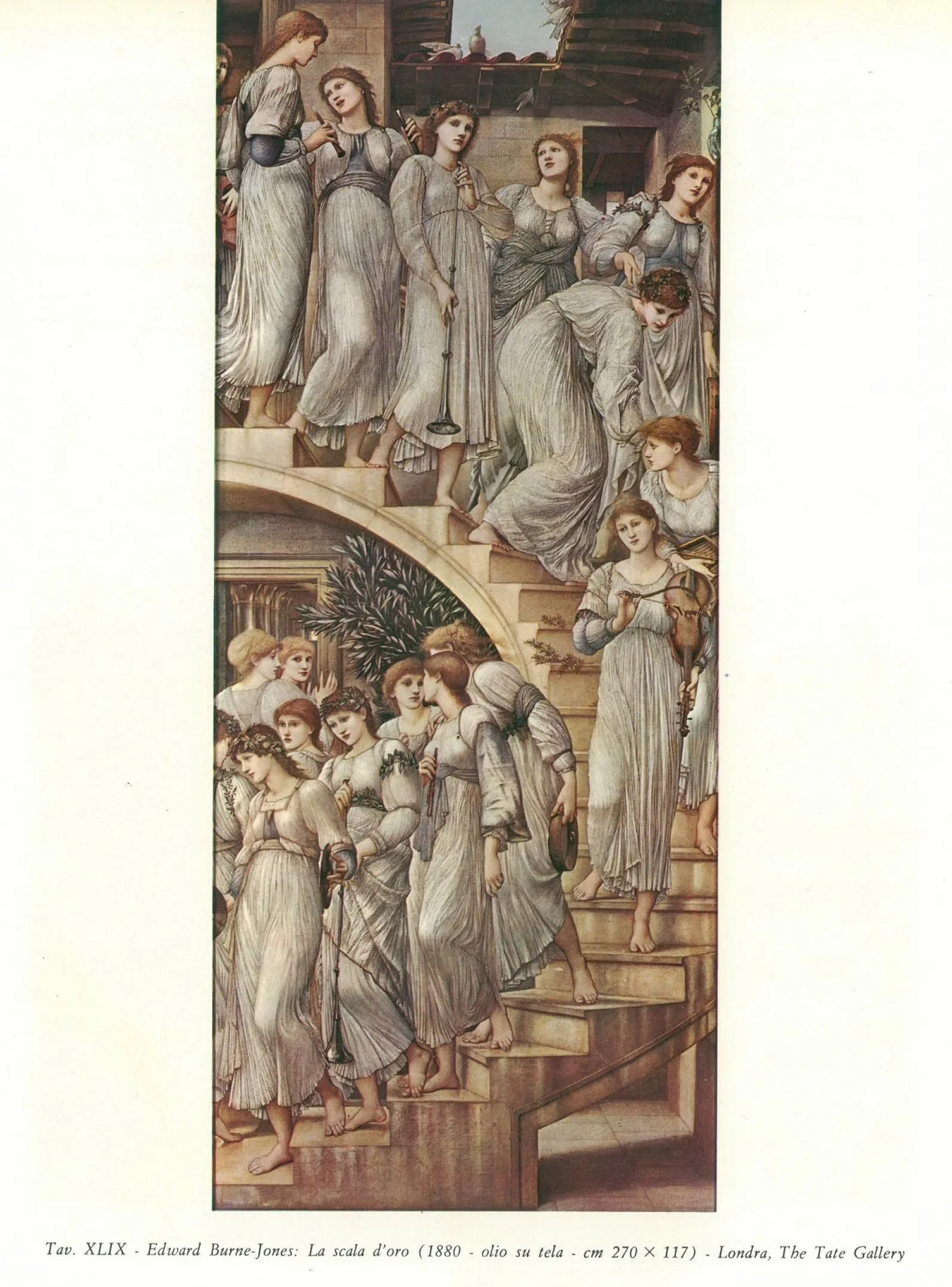
The Golden Stairs
Edward Burne-Jones · 1880
Oil on canvas
London, United Kingdom - The Tate Gallery
LDA · XIX · MMXXV
Source
Book · I Preraffaelliti di Renato Barilli · Fratelli Fabbri Editori · 1967 · p. 75
The Golden Stairs presents a procession of young women descending a staircase in continuous movement, without narrative incident. Burne-Jones draws from Renaissance processional imagery and medieval pageantry, yet removes identifiable story or myth, producing a deliberately timeless scene. The uniformity of the figures and their nearly identical drapery establishes a visual rhythm rather than individual characterisation. The downward movement may allude to the Neoplatonic idea of souls descending from the celestial to the earthly plane, a recurring framework in Burne-Jones’s work. The absence of a defined setting or plot reinforces the painting’s function as an allegory of harmony, beauty and ordered descent rather than a moment from literature.
Reposting welcome; please credit Libreria d’Arte - Studio Soli.
Detail
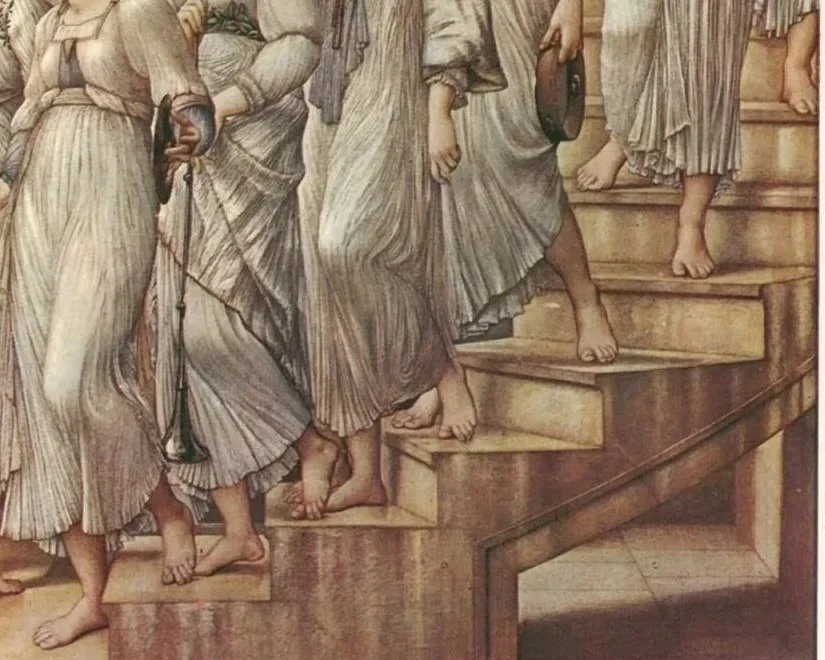
Musical instruments - the procession includes violin, trumpet, tambourine & other instruments associated with divine harmony in Renaissance allegory, indicating that the descent is governed by ordered beauty rather than by narrative action.
Detail
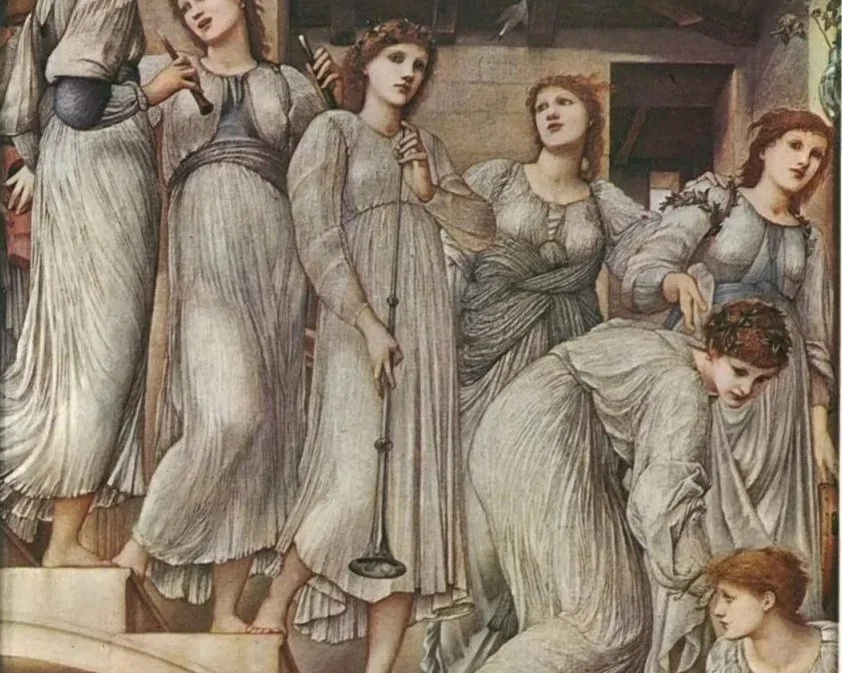
Uniform drapery - the near-identical garments suppress individual identity & produce a single visual rhythm, emphasising procession over personhood in alignment with Burne-Jones’s interest in idealised rather than psychological representation.
