
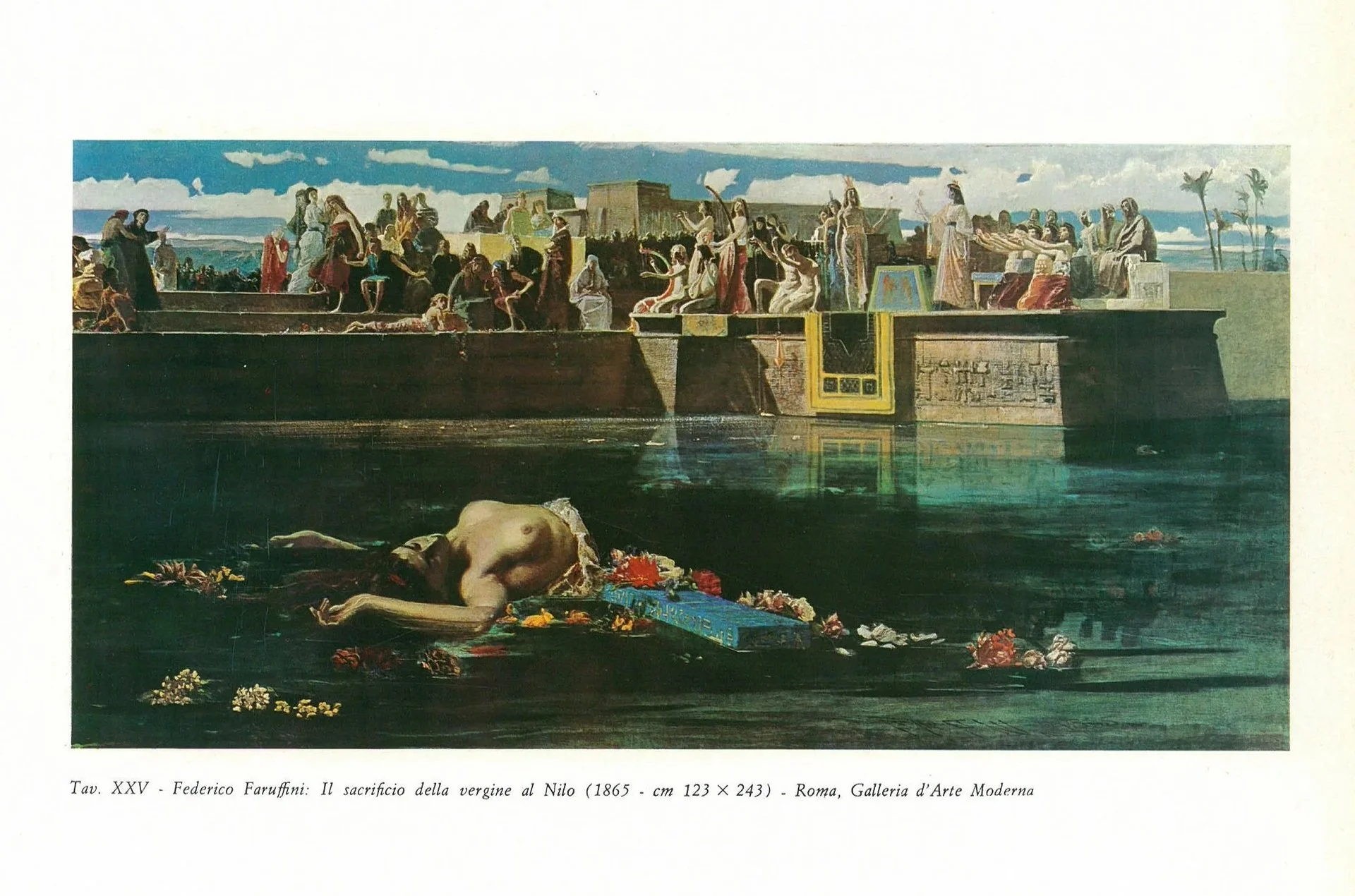
The Sacrifice of the Virgin to the Nile
Federico Faruffini · 1865
Oil on canvas
Rome, Italy - Galleria d’Arte Moderna
LDA · XXXV · MMXXV
Source
Book · Pittura Lombarda dal Romanticismo alla Scapigliatura di Gustavo Predaval · Fratelli Fabbri Editori · 1967 · p. 51
A vision of ritual practice in 19th-century historicism*. A scene based on a 19th-century European belief that ancient Egypt offered maidens to the Nile, a ritual now understood as a Romantic invention rather than a historical practice. Faruffini imagines an ancient Egyptian rite in which a young woman is offered to the Nile, framing the subject through a wide horizontal composition. The ceremonial group is set on the high embankment, arranged in a continuous frieze that recalls ancient reliefs and theatrical staging. Below, the body carried by the current occupies the foreground plane, surrounded by floating flowers that link the figure visually to the ritual on the platform. The large expanse of water separates spectators and offering, turning the river into an active field within the composition. Architectural blocks with carved motifs, distant palm trees and the clear sky complete the constructed image of an antique landscape.
*Historicism refers to the 19th-century artistic tendency to draw subjects, styles and symbols from earlier historical periods, reconstructing the past through a mixture of research and imagination. It seeks to evoke the visual character of the past rather than record events with historical accuracy.
Reposting welcome; please credit Libreria d’Arte - Studio Soli.
Detail
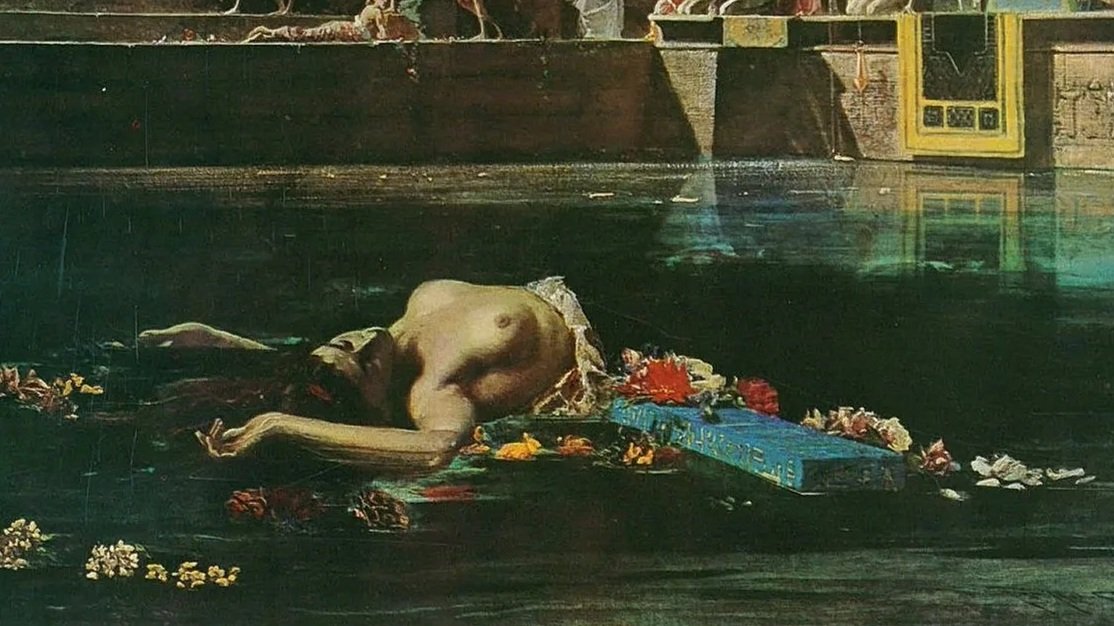
Floating body of the virgin - placed along the lower centre of the canvas as the focal point that connects the river surface with the ritual activity above
The offering corresponds to a 19th-century European myth of Nile sacrifice, rather than a historically attested Egyptian ritual
Garlands on the water - flowers drifting beside the body that extend the ceremonial action into the river, marking the current as part of the ritual space
Detail
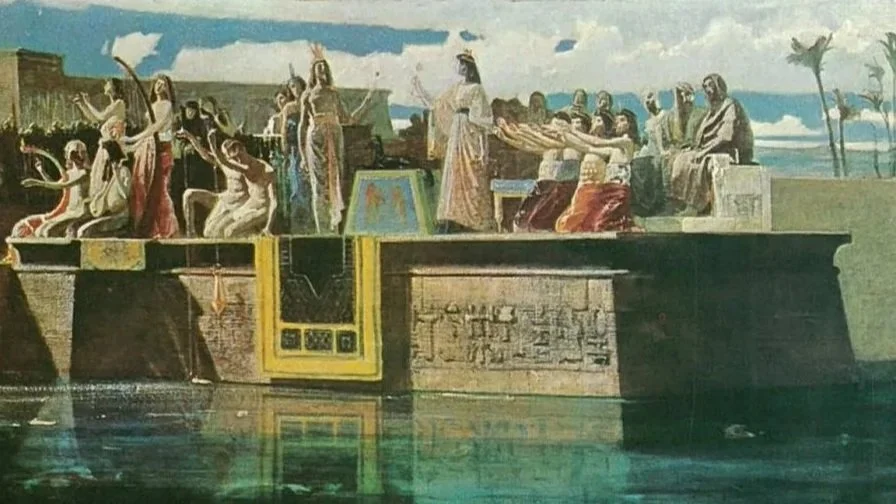
Priestly and aristocratic figures positioned above the crowd to mark ceremonial authority. Not based on any historical figures, these are fictional characters.
